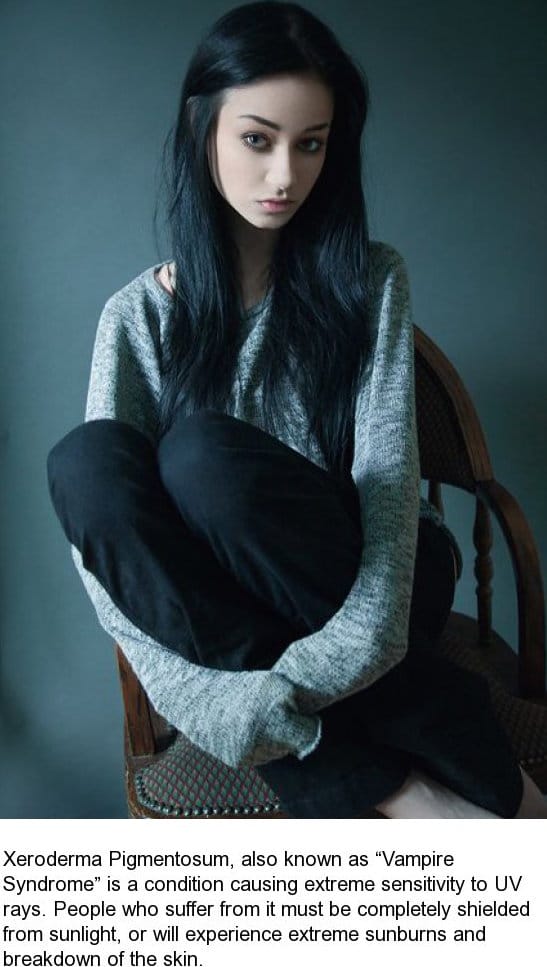
#10 Xeroderma Pigmentosum
Science has made lot of progress over the years.But there are still many things that we do not know about. Things like 10 of the rarest diseases in the world show us just what is possible.
Xeroderma pigmentosum causes severe sunburn when exposed to only small amounts of sunlight. These often occur during a child's first exposure to sunlight.Fewer than 40% of individuals with the disease survive beyond the age of 20.
#9 Fish Odor Syndrome
The condition seems to be more common in women than men, for unknown reasons. Scientists suspect that female sex hormones, such as progesterone and estrogen, aggravate symptoms. There are several reports that the condition worsens around puberty. In women, symptoms can worsen just before and during menstrual periods, after taking oral contraceptives, and around menopause. Can you imagine having to live with that? With no known cure, a lot of people do live with it.

#8 Nystagmus
Nystagmus, also called "dancing eyes," is a condition that involves involuntary eye movement.There are two types of nystagmus: congenital and acquired. Congenital nystagmus develops in infancy, usually between six weeks and three months of age. Unlike children with nystagmus, adults who acquire nystagmus may see images as shaky.

#7 Achromia
Achromia is also another name for albinism. In humans, there are two principal types of albinism: oculocutaneous, affecting the eyes, skin and hair, and ocular affecting the eyes only. Most people with oculocutaneous albinism appear white or very pale, as the melanin pigments responsible for brown, black, and some yellow colorations are not present.

#6 Oligodactyly
People with oligodactyly often have full use of the remaining digits and adapt well to their condition. Outside the occasional stare, they are not greatly hindered in their daily activities, if at all.

#5 Polymelia
Unlike what the picture shows you the extra limb is most commonly shrunken and/or deformed. An embryo which started as conjoined twins and eventually led to one twins complete degeneration except for one or more limbs is what leads to this appearance.

#4 Nevus of Ota
Nevus of Ota is caused by the entrapment of melanocytes in the upper third of the dermis. It is found on the face unilaterally and involves the first two branches of the trigeminal nerve. It gets its name from its first reported case of Dr.M.T. Ota of Japan. The images after this are not for the faint of heart. Go to the next page at your own risk.

#3 Necrotising Fasciitis
Necrotising fasciitis is a bacterial infection that can destroy skin, fat, and the tissue covering the muscles within a very short time. About 1 out of 4 people who get this infection die from it. While these images might be disturbing to us, there are people out in the world living and fighting these diseases every day. Go to the the next page to respect them and understand their problems.

#2 Neurofibromatosis
Neurofibromatosis type is a multi-system genetic disorder that is characterized by cutaneous findings, most notably spots and axillary freckling, by skeletal dysplasia, and by the growth of both benign and malignant nervous system tumors.Go to the next page to see the last and rarest disease.

#1 Hyperekplexia
Hyperekplexia is a condition that involves an extreme reaction to stimuli that causes uncontrollable jumps and startle-induced falls.Hyperekplexia is known to be caused by a variety of genes, encoding both pre- and postsynaptic proteins. The symptoms displayed, as well as the forms of heritance, vary based on which gene is affected.
Share this story if you understand the struggle these people go through on a daily basis.