#10 Terrafugia\'s Next Hybrid Car
We all know how great science is. Here\'s another reason. It\'s the Terrafugia\'s TF-X concept flying car that is also a Hybrid and a street legal plug-in. Can you imagine lifting-up from a highway during rush hour traffic and flying away?!
The next TF-X will have four-seats, collapsible wings, retractable propellers and an emergency parachute system. The best part is, it will be capable of driving and flying on its own!

#9 The Beautiful Death
Ever heard about The Ring Nebula? The Ring Nebula is a old relative of our Sun, but it's dying as it runs out of hydrogen fuel at its core. The size of its gas cloud spans 10-trillion kilometers across as it explodes. At one time it was estimated to be twice the size of our Sun, although it gives scientists clues to what someday will happen to our Sun.
The Ring Nebula has many names: NASA also dubbed the star, 'Cat's Eye Nebula' when the Hubble Space Telescope captured it in 1994, and it's official label is NGC 6543.

#8 Belly-button Organisms
Now this is a real shock. A very funny fact about the belly that we dont know. "Bacteria, fungi and yeasts are among the different types organisms found in the belly-button". If you have an 'innie', that moist space holds 100 different organisms, and microbial mixes differ between individuals too. The good news is we don't have mushrooms growing out our belly buttons, and the microbial benefit us by helping to fight off pathogens!

#7 Australia's Lake Hillier
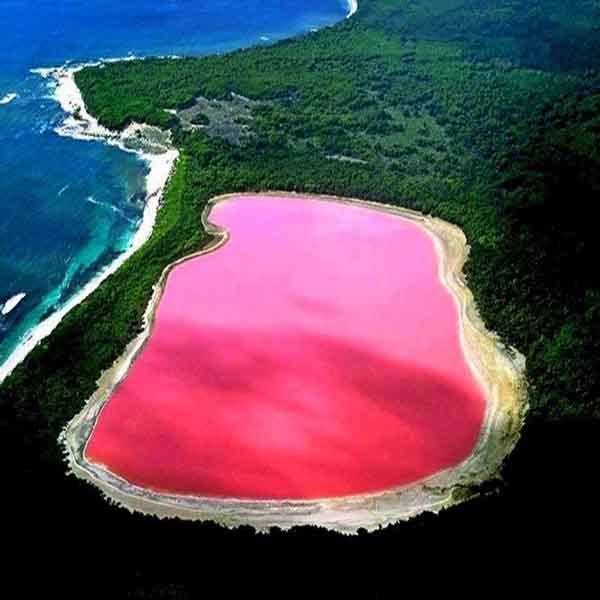
Whenever science an nature work together, a wonder is created. Here is an example. Australia's Lake Hillier is completely PINK in colour. Isn't it amazing?
After looking at this, the only question that comes to your mind is that is this otherworldly lake man-made? And the answer is No. Scientists believe its bright pink bubble-gum color is due to mother-nature.
#6 Killer Radiation on Mars
Man has done a wonderful progress in science. reaching Mars was certainly one of them. NASA's Mars Curiosity Rover has revealed the amount of radiation levels given off by the planet Mars would be at unsafe for astronaut exposure. Curiosity noted while traveling to Mars, the radiation was about "660 millisieverts during a 360-day roundtrip flight".
This finding puts a damper on our future goals to explore the Red Planet. Humans will have to be patient and continue learning through our robot companions like Rover.

#5 Eyes
New findings published by 'Psychological Science' could get us to schedule an eye exam.. or maybe not? It appears that a person's IQ is linked to the blood vessel size located at the back of the eyes. Blood vessels in the eyes share size, structure, and function with blood vessels in the brain; and blood supplies oxygen and nutrients. Simply WOW!

#4 A Scientific Remedy For Baldness?
So many people in the world suffer from baldness. People have long been waiting for a valid breakthrough on baldness, and now Penn University has studied a new Growth Factor (protein-Fgf9) that is showing promise. The scientists examined wounds and scars, where hair is known not to regrow.
They questioned why an adult person has blocked hair follicle growth upon wound-healing while mice do not? It appears that adult mice have the ability to create more Fgf9 versus adult humans. When scientist reduced the Fgf9 response in mice, their hair regrowth in wounds was in fact inhibited.

#3 Nudibranch: Sea Slugs
These creatures will make you fall in love with the nature and its naturality. These colorful creatures are an eyeful and a handful when being both predator or prey. With no shell for armor, they've developed vast strategies of survival. As a predator they ingest hydrozoids (jellyfish) which contain "stinging cells". They internalize the stinging cells and use them for their own defense system!
This Sea Slug species comes in all shapes, sizes and colors. Much like an octopus, they mimic their environment or sea plant-life as camouflage, and they have tentacles with which they, "touch, taste, and smell."

#2 Fairyfly: A New Species
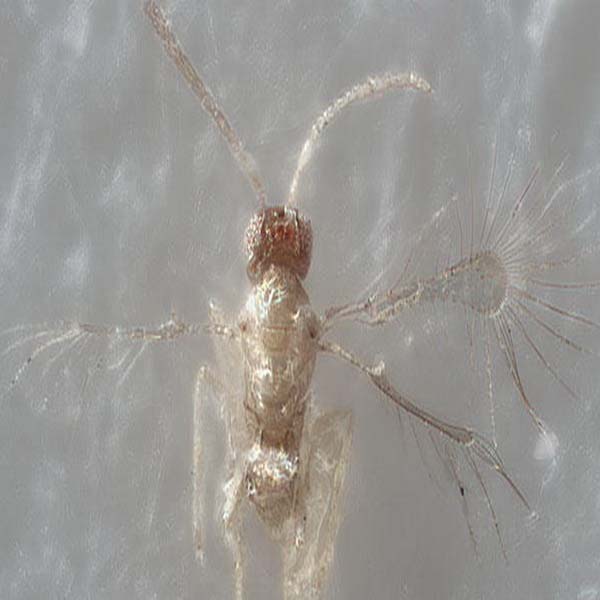
Here's a new species of an insect that you might not know. Tiny Tinkerbella nana is not make-believe! It's a fairyfly native to the Costa Rican forests. Its size defies logic, measuring only 250 micrometers long or 2.5 times the width of a human hair! How is it possible that this smallest known arthropods was even found?
Dr. John Noyes from the Natural History Museum, UK, and Entomologist Dr. John Huber carefully extracted specimens by hand after sweeping vegetation with a fine net. Dr. John Noyes says, it was "equivalent to finding a solitary needle in 200 haystacks."
#1 The Evolutionary Shell
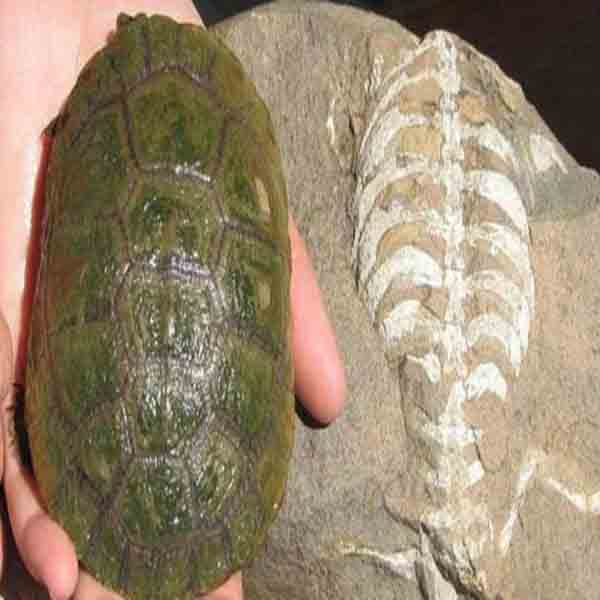
Everytime you see a turtle, you might be thinking about that hard coating of shell on it. Turtles are a novelty, no other animals share their incredibly hard external shell. Although an ancestor, the 260-million year old fossil, Eunotosaurus (on the right) has sparked new research. We see its structure, with ribs, shoulder bones and vertebrae from which the turtle evolved.
Turtles today are made up of around 50 bones that fuse together creating it's unique shell. Eunotosaurus share in the same T-shaped ribs but not the broad spine on its vertebrae or the fully flattened and fused ribcage. They also lacked the muscles that now grow between the ribs in turtles.
The ancient fossil almost looks recognizable, as if it's from the same family. By comparing the species of two eras, the Eunotosaurus has help scientist demystifies the turtle's evolutionary process.